Kodiak AI and Charger Logistics debut an autonomous freight service on a vital Dallas-Laredo route, aiming for driverless operations by late 2026.
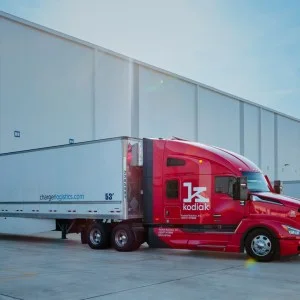
Kodiak AI, in collaboration with Charger Logistics, has launched an autonomous freight service covering the 435-mile route between Charger’s terminals in Dallas and Laredo, Texas. This new service aims to streamline the transportation of refrigerated and dry van freight for the consumer packaged goods and food and beverage sectors, with the inaugural delivery taking place on September 8 of this year.
At this stage, each autonomous truck is supervised by a safety driver, a temporary measure while Kodiak finalizes its safety case. The company’s Autonomy Readiness Measure, which quantifies progress towards safety and operational readiness, reached an impressive 96% by the end of September. This marks a notable increase from 93% in August and 84% in early 2024. Kodiak AI plans to transition to full driverless operations by the end of 2026 on the Dallas-Houston lane along Interstate 45, with previous tests of driverless trucks occurring in the Permian Basin since December 2024.
Significance of the Laredo Route
Laredo serves as the United States' busiest commercial land port of entry, which adds substantial importance to this newly launched service. In 2025, the Port of Laredo handled over $350 billion in international trade, accounting for nearly 40% of all U.S. trade with Mexico. This route is thus a crucial link for trading high-demand goods.
According to Kodiak, the reliability of consumer packaged goods and food and beverage shipments, which follow predictable retail replenishment cycles, makes this autonomous service particularly valuable. Efficient transit times and extended operating hours can greatly enhance the logistics chain, benefiting both the shippers and the suppliers involved.
Charger Logistics is an asset-based carrier with operations extending into both the U.S. and Mexico. Among its core service offerings is temperature-controlled freight, a segment where reliability and efficiency are paramount. The company employs a proprietary transportation management system along with various in-house applications to optimize its operations.
Andy Khera, president of Charger Logistics, remarked on the collaboration, stating, “Autonomy lets us build a network that serves both our customers and our drivers. Integrating our in-house transportation management system with the Kodiak Driver enables us to create a nearly fully automated ecosystem, providing our customers consistent service through fluctuating labor and freight demands while ensuring our drivers can return home each night.”
Future Expansion and Competitive Landscape
Under the Driver-as-a-Service model, Kodiak intends to deploy its autonomous driving technology onto trucks that Charger already owns and operates. Both companies are optimistic about scaling this technology and plan to add more lanes within Charger’s existing network over time.
Interestingly, Charger Logistics is also partnered with Aurora Innovation, focusing on the same Dallas-Laredo route. Their agreement, announced in late July, outlines a transportation-as-a-service framework whereby Aurora takes charge of the second-generation driverless trucks. In this arrangement, Aurora manages the technical aspects, including insurance and compliance with U.S. Department of Transportation regulations.
Don Burnette, founder and CEO of Kodiak, emphasizes the strategic significance of this partnership, saying, “Charger approached us with a clear vision on how they anticipate the integration of autonomy into their operations. This new Dallas-Laredo corridor adds a fresh dimension to our existing capabilities and lays the groundwork for scaling the deployment of driverless freight services.”
As the competition in autonomous freight intensifies, partnerships like those between Kodiak and Charger, as well as with Aurora, highlight the industry's commitment to evolving supply chain efficiencies through technology. Companies are closely watching advancements in autonomy, as they could reshape logistics operations and labor dynamics in the coming years.
The Dallas-Laredo route not only opens new lanes for Kodiak's technology but also sets a precedent for future collaborations in autonomous trucking. As this space continues to evolve, stakeholders will be keen to observe how the integration of these technologies impacts operational costs, freight delivery speeds, and overall reliability in the logistics sector.
For those involved in freight transportation, the outcomes of these initial deployments will help inform future investments and operations in the rapidly advancing field of autonomous logistics.


